A Hook or a Button for a Mended Fastening?
A hook or button for a mended fastening depends on how an opening lies and how you use it. Compare their fit, handling, and best-suited openings.
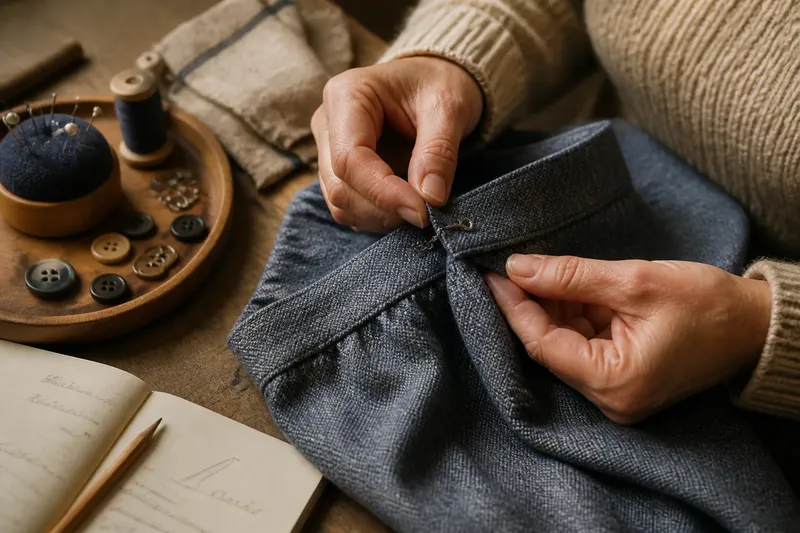
The most common mistake in choosing a mended fastening is treating a hook and a button as interchangeable little bits of hardware. A hook or button for a mended fastening changes how an opening lies, how your fingers close it, and how much room the cloth needs; the wrong choice can leave a gap, a lump, or a closure that catches on nearby fabric.
Think of the decision as a question of movement, not decoration. A button needs a loop or buttonhole to pass through, while a hook catches an eye or a small fabric loop. That difference determines where each sits comfortably and how the opening behaves as you move.
Choose by how the opening needs to lie
A button bridges two edges with visible overlap. When fastened, its face remains on one side and its shank or sewing thread holds the cloth away from the buttonhole edge. This can suit a front opening that is meant to read as a series of distinct closures rather than one uninterrupted seam.
A hook-and-eye draws the edges together at a small point, usually with little visible bulk. It is useful where the closure should be discreet or where a smooth outer surface matters. The hook itself needs a secure anchor, and the eye must land opposite it; a mismatch makes the edges pull diagonally instead of meeting neatly.
Inspect the opening while it is resting naturally. If the edges overlap and can be brought together without twisting, a button may sit well. If they meet edge to edge and a low-profile catch is desirable, a hook and eye may be the more natural arrangement.
Compare the way each closure works under your fingers
Buttons ask for a small, deliberate action: align the button with its opening, then push and draw it through. A button with a broad face can be easier to locate by touch, though a tight or frayed buttonhole can make fastening fiddly. The button also gives the hand a clear target, which is useful when the closure is placed where you can see or feel it readily.
A hook is operated by catching its tip into an eye or loop, often with a short sideways motion. It can be quick once the two parts are aligned, but the hook may be harder to manage by touch alone, especially if it is tiny or hidden under a flap. A metal hook can also snag delicate lining or loose threads if its point is exposed.
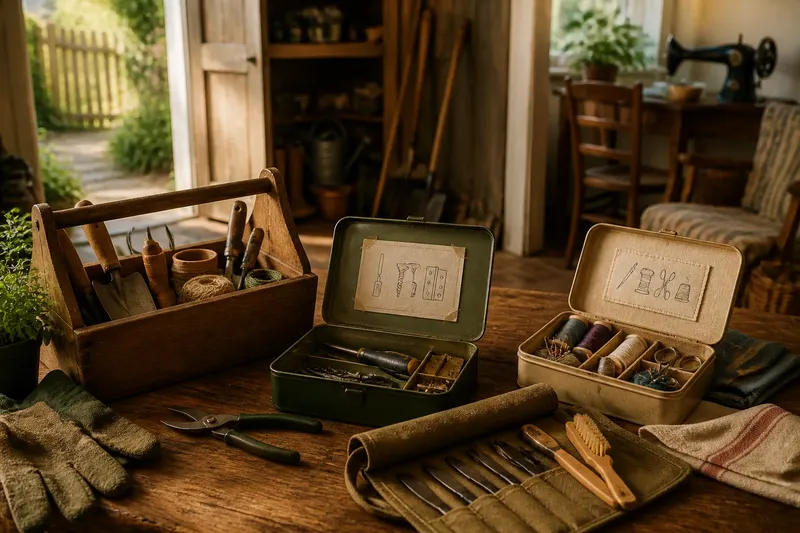
Consider the wearer’s usual movements, too. A closure handled often may benefit from an obvious grip; one that is meant to disappear beneath a waistband or overlapping edge may benefit from a small, flat profile. The best fastening is not necessarily the one that looks smallest in a tin.
Match the closure to the kind of opening
Buttons commonly suit openings with repeated closure points, such as a shirt front, cuff, or pocket flap. They spread the visual rhythm along the opening and can be spaced to hold the edges in place at several spots. They also need enough cloth around each buttonhole to resist strain.
Hooks and eyes often suit a short, firm closure where a discreet catch is more useful than a visible button. A waistband overlap, a narrow neck opening, or a small gap beneath another fastening may call for that kind of low-profile hold. They do not, by themselves, distribute pulling force along a long opening.
For an opening that shifts or bows between fastening points, neither closure should be expected to correct the cloth’s shape. The opening may need its edges supported or its existing construction preserved. A fastening joins edges; it does not persuade stretched fabric to behave as it did before.
Plan the choice across a week of ordinary use
A week is a practical period for noticing what a fastening must do, without turning a small repair into a household project. On the first day, look at the opening while the garment or item is laid flat. Note whether the edges overlap, meet, or pull apart, and whether the closure is meant to be visible.
During the next few ordinary uses, pay attention to the motion required. Does the wearer reach for the closure with one hand or two? Is it easy to see? Does it sit under a belt, apron, coat edge, or another layer? These observations tell you more than choosing between a shiny button and a tidy hook in the sewing box.
Near the end of the week, compare the available materials with the fabric. A button needs a buttonhole or a loop that fits its thickness; a hook needs an eye or loop aligned closely enough to catch without forcing the edges. Use matching thread and a needle suited to the cloth, and avoid adding a closure that rubs against a neighboring layer.
Say you have a skirt opening that overlaps beneath a belt and is usually fastened while standing. If the overlap already lies flat and the existing buttonhole remains sound, a button may preserve the familiar action; if the visible face catches under the belt, a discreet hook and eye could reduce that obstruction. The useful observation is whether the closure clears the belt during ordinary wear, not which option looks more ingenious on the table.
Questions that help settle a hook or button choice?
Can a hook replace a missing button?
Only if the opening’s shape and existing construction allow the edges to meet where the hook can catch. A hook will not pass through a buttonhole or provide the same visible overlap, so check how the opening is meant to sit before changing its closure.
Is a button better for an opening that is used often?
It can be easier to find and grip, especially when its face is large enough to handle comfortably. The buttonhole must also be easy to use; a stiff, damaged opening can cancel out that advantage.
When is a hook and eye less noticeable?
It is often less visible when placed beneath an overlapping edge or inside a narrow opening. Its position still matters: a proud hook or poorly aligned eye can show, snag, or pull the cloth out of line.
What should I check before sewing either closure on?
Check the fabric’s thickness, the opening’s overlap, the space available for the closure, and the direction in which the cloth pulls. Follow care labels and any maker’s instructions where they apply; for an item with a specialized fastening or construction, consult a qualified repair professional.
Let the opening make the decision
Before sewing, hold the edges in their natural position and place the proposed closure where it would sit. Check that a button can pass through its opening without dragging the fabric, or that a hook can catch its eye without making the edges twist. A few moments of positioning can prevent a tidy repair from becoming an awkward one.
For a mended fastening, choose by the opening’s shape and the hand motion it allows. A button makes a visible bridge; a hook makes a compact catch. Keep that distinction in mind, and the sewing box can remain a useful collection rather than a small parliament of competing opinions.