Why a Woven Basket Keeps Its Shape
Why a woven basket keeps its shape depends on crossings, spacing, and sound edges; use this inspection checklist to judge support before choosing one.
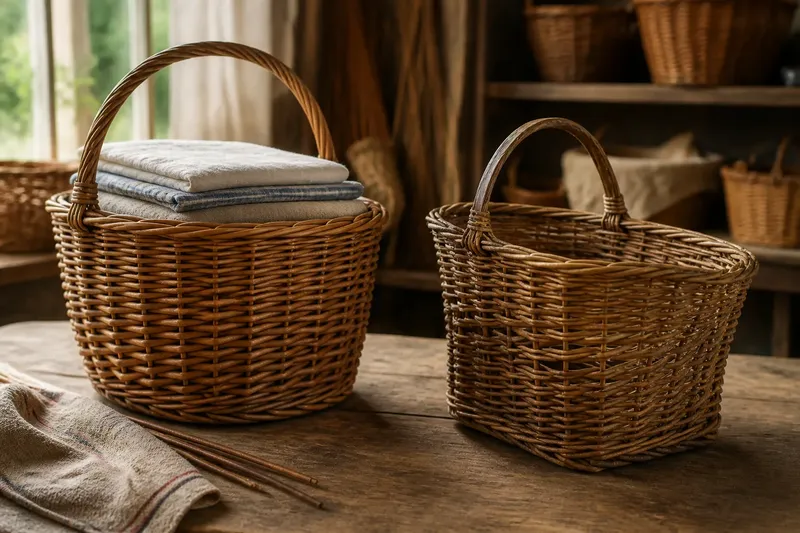
The common mistake with a woven basket is to judge its shape by the rim alone; a neat edge can conceal a body that slumps as soon as it holds anything. Why a woven basket keeps its shape depends on how its strands share pressure, and a quick inspection of the crossings, spacing, base, and rim can reveal where support is sound or missing.
Crossings turn loose strands into a supporting surface
A single reed, willow rod, or strip of split wood is flexible along its length. Woven across other strands, it has less freedom to move: each crossing presses against a strand running in another direction.
In a plain over-under weave, one set of strands forms the uprights, often called stakes, and another passes around them as weavers. The stakes give the wall its vertical route; the weavers connect them around the circumference. Push the wall inward and the load travels across a sequence of crossings rather than meeting one solitary stem.
This does not make a basket rigid. A useful basket has some give, and natural materials respond to handling and moisture. The aim is a wall that flexes without collapsing or cracking under its intended use.
At each crossing, look for contact, not merely a strand that appears to pass over another. A loose crossing may slide when the wall is pressed. Snug, repeated crossings help keep strands in place.
Strand direction and spacing affect the wall together
Upright stakes connect the base to the rim, and their spacing helps set the body’s shape. Evenly distributed stakes give the weaver a reasonably regular route around the basket. If several bunch together or drift apart, the wall may form a flat patch, bulge, or narrow channel.
Horizontal weavers bind the stakes together and describe the basket’s circumference. The two directions resist different kinds of movement: stakes help retain the wall’s height and outline, while weavers limit separation between stakes.
Some baskets use paired stakes or diagonal patterns. These alter how movement travels through the wall, but no pattern makes loose crossings sound. Follow one weaver around a section: a steady course is reassuring, while a sudden gap or loose run leaves a local area with less support.
Spacing is not a contest to pack in as much material as possible. Close rows can make a wall feel firm, but overcrowding may strain the strands and make sound crossings harder to distinguish. Wider spacing allows more flex and can suit light, bulky contents, though stakes have more room to move.
Consistency matters more than perfect uniformity. A sudden change in spacing can concentrate movement at the transition, so inspect the broad middle panels as well as the corners and rim.
A short inspection checklist points to the right decision
Use this checklist before choosing a basket or deciding whether a particular area needs attention. Handle it gently; the aim is to observe ordinary flex, not to force the weave.
- Look for gaps that interrupt the pattern. If a gap is isolated and the neighboring crossings remain seated, treat it as a local irregularity; if several gaps form a loose patch, choose a more evenly supported basket for contents that press against the walls.
- Press a wall lightly with your palm. If it flexes and returns without strands shifting, ordinary give is not a reason to reject it; if a section stays dented or moves independently, avoid relying on that panel for support.
- Follow a weaver around the side. If it keeps a steady course, its route is connected; if it wanders abruptly or leaves a broad opening, inspect the surrounding rows and favor another basket for a demanding use.
- Check the stakes from base to rim. If they rise at regular intervals without a crowded cluster, the wall has a more even framework; if they bunch or spread sharply, expect an uneven outline and choose a sounder body for close-packed contents.
- Set the basket on a level surface and check whether it rocks. If it sits steadily, the base is not visibly pulling the body off balance; if it rocks or twists, do not use that unstable base for a load that needs to sit level.
- Inspect the rim and the strands around any handle. If the edge is bound and nearby strands stay in place under gentle handling, the top is better restrained; if it opens, frays, or shifts, avoid lifting a filled basket by that area and seek repair advice if the basket matters to you.
Say you are choosing between two willow gathering baskets for folded cloth. The first has even stakes, seated rows, a steady base, and a bound rim; the second has a broad loose patch midway down one side and rocks on the shop floor. Since the cloth may press outward and the second base is unstable, choose the first for that job; the second may still suit light, loose material that does not need to sit level.
The base and rim anchor the woven body
The base sets the stakes’ starting positions. If its intersections shift, the wall may rise unevenly even when the side weave looks regular. Watch where the wall meets the base for abrupt kinks or a crowded cluster that pulls one section inward.
The rim gathers and restrains the ends of the stakes, helping prevent the top from spreading during handling. It cannot compensate for widely separated or wandering stakes below, but it can keep a sound body from fraying at the edge.
Handles create a local demand. A handle attached through the rim transfers lifting force into the surrounding weave, so nearby strands may be reinforced or closely bound. Use the intended handle or support the basket under its base as appropriate; do not assume a delicate rim is meant to carry every load.
What should you inspect before choosing a basket?
Does a diagonal weave hold its shape better?
Not automatically. Diagonal strands direct movement differently, but stability still depends on snug crossings, consistent spacing, and secure edges.
Why does one side bulge?
A bulge can come from irregular stake spacing, a wandering weaver, or a base that does not sit evenly. Check the pattern around the whole basket before blaming one protruding strand.
Can a woven basket be pressed back into shape?
A slight, gradual lean may be part of the basket’s working form, while a sharp kink or loose crossing may indicate damage. Avoid forcing a dry basket into a new outline; for material-specific care or repair, ask the maker or an experienced basket worker.
Match the weave to the basket’s work
For dry kindling, folded linens, or garden produce, consider how contents will press against the wall and whether the basket needs to travel while full. A compact weave and well-bound rim may suit heavier or more contained loads; a more open wall may be adequate for light, bulky items that do not push hard against one side.
For storage, set the basket on a base that does not rock. If baskets are nested, check that the upper one is not wedged tightly enough to distort the rim or press a wall inward.
Why a woven basket keeps its shape is easiest to judge by tracing a strand through its crossings, then checking the spacing, base, and rim. Use the inspection checklist to distinguish ordinary flex from a loose patch, and match that condition to the work the basket will actually do.