The Myth of the One Place for Every Tool
Tool storage by task keeps household tools easier to find, return, and use without forcing every hammer, snip, and brush into one crowded cupboard.
The most common mistake in household tool storage is insisting that every tool belong in one place. Tool storage by task avoids the usual cost: a crowded cupboard where a pruning knife sits beside a mending needle, while the screwdriver needed for a loose gate latch has wandered elsewhere.
A household collection serves several kinds of work, often in different parts of the house and yard. The useful question is not whether all tools can be gathered together, but which tools need to meet at the moment a particular job begins.
This does not mean scattering tools wherever they were last used. It means assigning a dependable home to each working group, then making those homes easy to recognize and maintain. A tool can have a place without sharing a room with every other tool.
One central cupboard can make ordinary work harder
A single cupboard seems tidy because it puts the collection behind one door. The arrangement starts to fail when the cupboard holds items for tasks that happen in unrelated places: sewing shears, a hand rake, a sharpening stone, a tin of screws, and the brush used to clear ashes from a stove.
The trouble is often not a lack of storage but a mismatch between storage and use. A person carrying a loose hinge indoors has to fetch a tool from the yard shed, while someone mending a coat walks past the same shed to reach a sewing box on another floor. The cupboard has concentrated the objects but lengthened the work.
Try tracing a few recurring jobs from their starting point. Note where the work happens, which tools are commonly needed together, and which items are awkward to carry back and forth. Keep a group near its work if doing so is sensible and dry; move it elsewhere only when the location creates a real problem.
Put tools where their work begins, not where an empty shelf happens to be.
Mixed storage hides the group a task actually needs
When every loose tool shares one drawer or box, finding one can require shifting several unrelated objects. A small awl may disappear beneath a pruning saw, and the cloth used to polish silver can become entangled with a bundle of twine. Neither item is lost; both are simply stored in a way that makes them inconvenient.
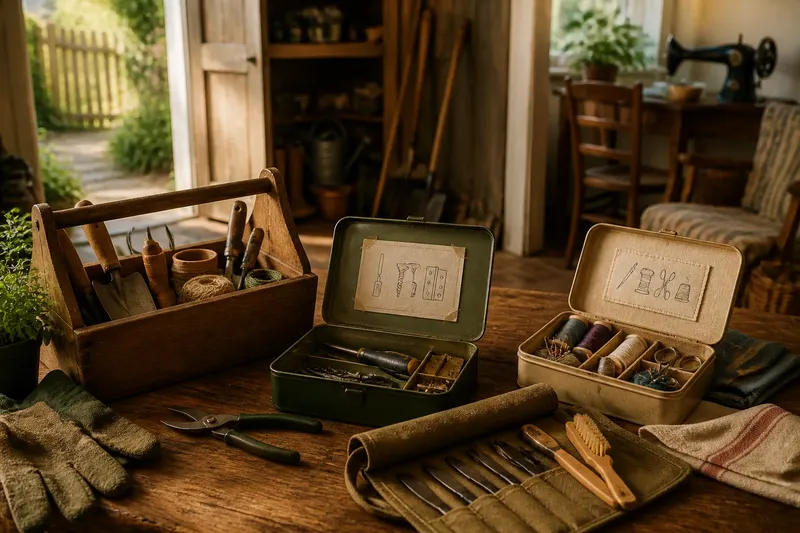
Group tools by the work they support rather than by appearance alone. A household may keep a mending tin with needles, thread, thimble, and a small pair of scissors; a garden caddy with hand trowel, plant labels, and twine; and a latch-repair box with a screwdriver, spare screws, and a modest selection of hinges. These are working groups, not miniature versions of a hardware store.
Say you keep finding the same screwdriver under a pile of sewing supplies because the central drawer is the only place with room. Move the screwdriver and the small fasteners used for gate and shed latches into a labeled tin near the usual repair area; the expected result is that the next small adjustment starts with the relevant items together, rather than with a search through thread and buttons.
Keep the group narrow enough to be legible. A container labeled “household” is a confession, not a useful instruction.
Tools left at the point of use can drift into clutter
Local storage has its own failure mode. A tool left near every task can multiply into stray screwdrivers on windowsills, spare shears in coat pockets, and brushes that have acquired permanent residence beside a doorway. Convenience has turned into a collection of loose ends.
Give each task group a container or a clearly bounded shelf. A shallow wooden tray, a lidded tin, or a canvas roll can keep the contents together without requiring a large cabinet. Choose something that can be carried to the work and returned in one trip, but not so large that unrelated objects begin to settle inside it.
Use a simple return cue: a drawn outline on a pegboard, a named compartment, or a short contents list inside the lid. The cue matters most for tools that look alike or are easy to overlook, such as a small file, a thread snip, or a stubby driver. It need not be elaborate; a strip of paper and a pencil can do the job.
If a container becomes difficult to close, sort its contents before buying another one. The extra capacity may only give clutter a new address.
Duplicate tools raise a question of access, not neatness
Some households resist task-based storage because it seems to require duplicates. A screwdriver in the kitchen drawer and another in the shed may look wasteful when both are the same kind. Yet a tool used repeatedly in distant places can be more useful when each working area has a suitable one, provided the household can keep track of them.
Do not duplicate a tool merely because it has wandered. First choose a home for the original and see whether that home suits the work. Consider a second tool only when carrying the first back and forth causes repeated interruption, or when two people often need the same kind at once.
When duplication makes sense, keep the two tools in distinct groups and label them by location or task. A spare hand pruner kept in a second garden caddy should be a deliberate reserve, not evidence that the first one has gone missing. For specialty tools used rarely, a shared central location may remain the clearest arrangement.
Let frequency and distance decide whether a second tool earns its place.
Moisture and dirt can make a convenient location unsuitable
A task group should be close to its work, but not every nearby spot is fit for storage. A damp shed can rust metal edges; a sink-side drawer can leave wooden handles exposed to repeated splashes; an unprotected shelf near a stove can collect grease and dust. A useful location preserves the tool as well as making it accessible.
Choose storage according to the materials involved. Keep metal tools clean and dry before putting them away, give sharp edges a guard or a protected compartment, and avoid trapping damp cloths or soil-covered items in a closed box. A ventilated shelf may suit garden hand tools better than a sealed tin, while needles and small sewing fittings benefit from a container that prevents spills.
Put a group in the nearest suitable place, not simply the nearest place. Where a tool’s care or storage depends on its label, maker’s instructions, or local rules, follow those directions.
How should household tools be grouped by task?
Which tools belong in a household mending kit?
Start with the tools used for the repairs your household actually makes, such as needles, thread, a thimble, and scissors suitable for fabric. Add a seam ripper or small measuring tape if they serve regular work, rather than filling the kit with items that have no assigned job.
Should garden tools stay in the garden?
Frequently used hand tools can live near the garden if the storage spot is dry and keeps cutting edges protected. Tools that need indoor care, or are used across several parts of the property, may belong in a shared utility area instead.
What should a tool container label say?
Name the task or location in ordinary terms, such as “mending,” “garden hand tools,” or “gate and shed repairs.” A label should help someone return an item without needing to guess what the container was meant to hold.
How can you tell when a group is too large?
If the contents serve several unrelated jobs, or the useful items are difficult to see and lift out, split the group by task or remove items without a regular role. Keep related tools together only when the grouping helps the work rather than merely filling a box.
A storage system needs a way to recover from drift
Even a clear arrangement will loosen over time. A tool gets borrowed, a seasonal job calls for a temporary bundle, or someone puts an item away in the nearest empty drawer. The system becomes hard to trust when those temporary homes quietly turn permanent.
Make returning tools part of finishing the job. Gather the working group, wipe off dirt or residue as appropriate, check that small parts have not spilled, and put the container back in its assigned spot. If an item repeatedly lands elsewhere, adjust the home or the task group instead of treating every misplaced tool as a lapse in discipline.
Keep one modest shared area for items that genuinely serve many jobs, such as a tape measure or a general-purpose brush. That exception prevents task grouping from becoming a rigid rule. Tool storage by task works best when the arrangement reflects the household’s real work and can change when that work changes.
Make the next task easy to begin, and the tools are more likely to find their way home afterward.